When “Fine” Is Camouflage: Finding the Words for What We’re Really Feeling
Someone asks, “How are you?”
You reply… “Fine”… or even, “Good, thanks!”
It’s one of those little social exchanges most of us barely think about.
Sometimes we really are fine. Sometimes “fine” is just conversational shorthand because we’re passing someone in a hallway and neither of us has time for an in-depth discussion about the current state of our emotional lives.
Sometimes it’s a boundary. We don’t owe everyone access to what’s going on inside us.
But sometimes…
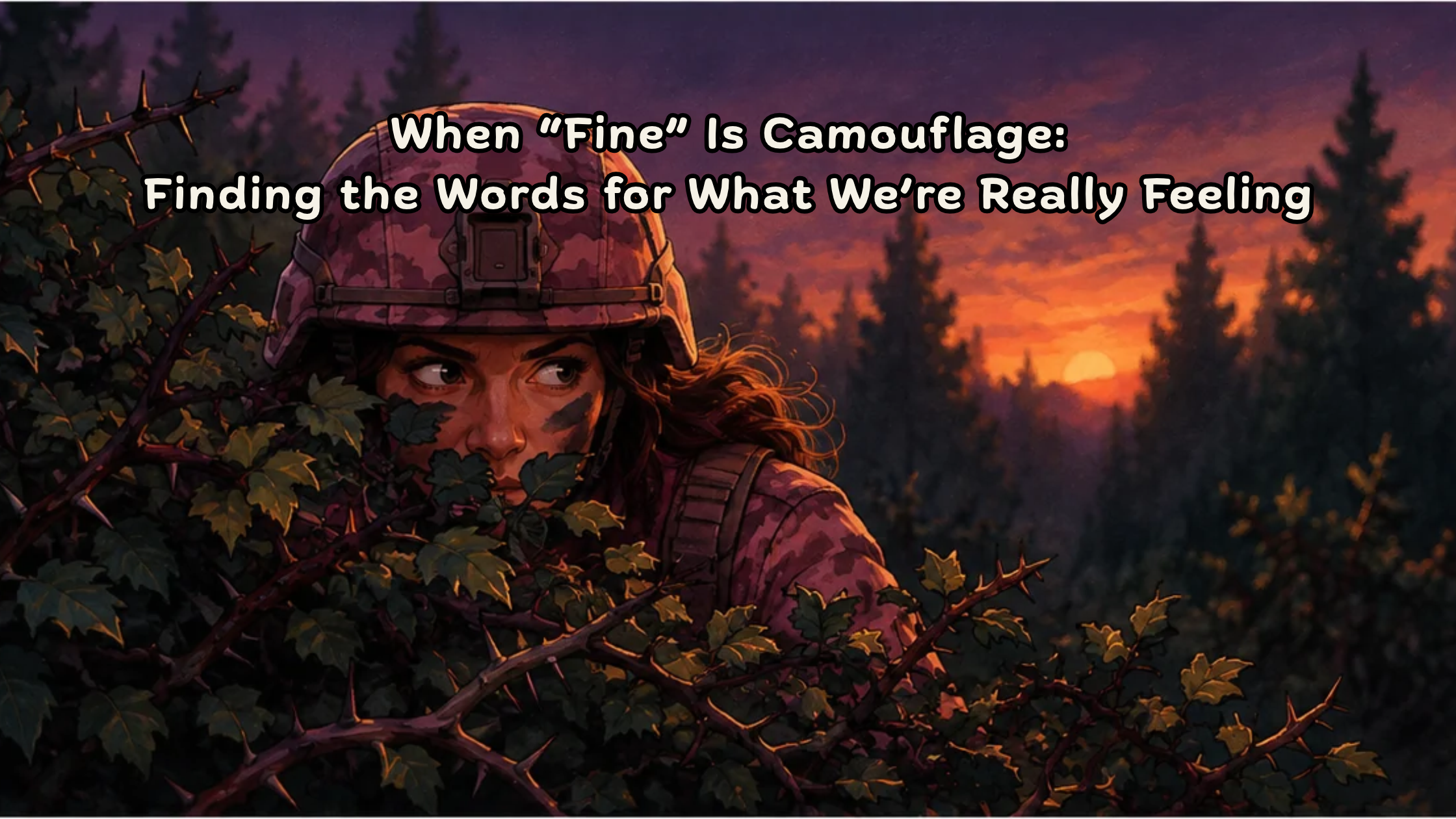
“Fine” is camouflage.
And recently, I caught myself wearing that camouflage. Again.
When “Fine” Isn’t Really Fine
My son Micheal died as a result of a workplace injury twenty years ago. For more than a year afterward, “fine,” “okay,” and even “good, thanks” became automatic responses whenever someone asked how I was doing.
Meanwhile, I was anything but fine.
Because somewhere along the way, my somewhat less emotionally mature self had decided that “fine” was what people wanted - or perhaps needed - to hear. It made people smile. It prevented more questions.
And eventually… it became automatic.
Twenty years later, after a whole lot of work on personal growth, after building a pretty solid resilience toolkit, when I’d actually been facilitating workshops about resilience… and doing more than fifty episodes of a podcast about navigating the messy parts of being human…
Well, I caught myself doing it again. And the thing that troubled me this time was that I was even doing it with people I loved and trusted to support me.
And somewhere within that realization came another realization… I know I’m not fine… but I have no idea what the fuck I’m actually feeling right now.
And with that, the realization that in spite of having a pretty decent emotional vocabulary, I was burying a whole bunch of emotions under a big pile that I’d just broadly labelled “overwhelm”.
When Everything Becomes “Overwhelmed”
I kind of had a lot of shit going on during most of this year. No catastrophic events. No monumental challenges, or experiences that caused my world to shift under my feet. Just what felt like an ongoing, ever-building accumulation of stress and difficult experiences, with some chronic pain and my daughter and her family moving to another province - including two little boys who own a significant chunk of real estate in my heart – tossed in for good measure.
But as one experience kept piling on top of the last unresolved experience, it all just built up until everything had amalgamated and blurred into one giant emotional blob I could only describe as, “Overwhelmed”.
And I was definitely fucking overwhelmed. But that wasn’t the emotion I was feeling. It was the outcome.
And it took some serious work to pull apart the mess and tease out my feelings and emotions so I could actually deal with them. It started with some journalling, some quiet time alone on my back porch, and some lunch hours sitting alone in my pickup truck picking my own brain… and eventually realizing that I needed to reach out for some professional support, to help me start separating some of the pieces.
There was frustration… Uncertainty… Fear… Sadness that I eventually recognized as grief… Guilt… Shame… Exhaustion… And probably a few more things I’m still working on identifying.
I’ve understood the importance of Emotional Intelligence for a long time. The ability to more accurately name our emotions – and how that can help us label our emotions a bit more honestly.
This emotional shit-show introduced me to the importance of emotional granularity – which is the ability to distinguish between emotional experiences with greater precision.
Emotional granularity isn’t about becoming a walking emotional thesaurus. I’m not talking about replacing perfectly good words like “sad” or “unhappy” with something more poetic, like melancholy, when “sad” describes what you’re feeling perfectly well.
The way I think of it is more like a zoom lens. Maybe what initially looks like anger, if you look at it a little more closely, is actually resentment… frustration… hurt… or feeling dismissed. Maybe “stress” is actually uncertainty. Maybe sadness is disappointment. Maybe it’s loneliness – but maybe it’s grief.
And let me be clear. It’s not a magic bullet to fix the underlying issues behind our emotions. Greater precision doesn’t necessarily make the emotion disappear – but sometimes it can give us a place to start.
More Than One Thing Can Be True
One of the difficulties I was experiencing was just separating the actual emotions out of the pile that I’d labelled “Overwhelm”. But then came what felt like an even more difficult undertaking.
Correctly labelling some of those emotions took a bit of time. One of the emotions that I struggled to identify was grief. An emotion that I should be intimately acquainted with.
My daughter, son-in-law, and grandsons moved to another province. I’m genuinely happy for them. They have great opportunities where they are now, and are building a good life for their family.
I thought I was sad. And I am. But what I also am, is grieving.
Both things are true.
Which brings me to another important part of emotional fluency. We aren’t necessarily searching for that one “correct” emotion buried in the pile. Emotions can be messy. And I don’t mean slobbering all over someone’s shoulder crying, messy… I mean “Holy fuck… where did that come from?” messy.
Sometimes we love someone and we’re angry with them. Sometimes we’re excited and terrified. Sometimes we’re happy for someone and deeply sad about how their decision will impact us – and don’t get me started about how guilt can crash the party when that happens.
Emotions can coexist - even when they feel like they contradict one another.
And once I started my emotional excavation, I also encountered the problem that it wasn’t just identifying that it was grief. Once I found ‘grief’…
I started arguing with myself about whether I had a right to feel it about this.
The Shitty Little “Shoulds”
I’ve lost a son. Really lost him. He’s dead.
No phone calls. No text messages. No periodic travel plans to get together for the holidays.
My grandsons moved away. But they are alive and healthy. I can call them. Video chat with them. Get on a plane and visit them.
They didn’t die. So why the hell was I experiencing this much grief?
And that’s when the “shoulds” arrived.
“I’m resilient. I should be handling this better.”
“I’ve survived worse. I should be able to cope with this.”
“I have a resilience toolkit. These tools should be working.”
“I teach a fucking workshop about resilience. I should be able to deal with this myself.”
And when I eventually realized I needed some time away from work - in walked…
“I shouldn’t be creating more work for someone else.”
And quietly trailing behind almost every one of those “shoulds” was another emotion.
Shame.
I wasn’t only struggling. I was ashamed that I was struggling.
I wasn’t simply grieving. I was judging whether my grief deserved to exist in proportion to other grief I’d experienced.
I wasn’t only overwhelmed. I was attaching meaning about who I was to the fact that I was overwhelmed.
And that made me realize something important about emotional fluency. Sometimes it’s not just about recognizing what we’re feeling. Sometimes we also need to notice what we’re doing to ourselves because we’re feeling it.
There’s the original emotion… And then there can be our emotional response to having that emotion.
We’re angry - and then judge ourselves for being angry.
We’re envious - and wonder what kind of person feels that way.
We’re grieving - and tell ourselves other people have experienced worse.
We’re overwhelmed - and decide that means we’re weak or worry that we’re incompetent.
Suddenly, instead of carrying one difficult emotion, we’ve piled judgment, guilt, or shame on top of it. And sometimes all three.
Sometimes the first thing we need isn’t to figure out how to change an emotion. Maybe we need to stop cross-examining ourselves about whether we’re entitled to feel it.
Emotions Are Information, Not Instructions
Just because we’ve named an emotion doesn’t mean it’s an accurate assessment of everything happening around us.
Fear can tell us to pay attention without necessarily meaning we’re in danger. Anger might point toward frustration, hurt, unfairness, or a crossed boundary. Envy might help us recognize something we want without meaning we begrudge someone else for having it.
Our emotions give us information. They don’t necessarily give us instructions. We can listen without automatically handing them the steering wheel.
But it helps if we can figure out which emotions are sitting in the passenger seats in the first place.
“Name It to Tame It”
There’s a popular phrase for something psychologists call affect labelling. It’s “Name it to tame it.”
Cute way to say that if we can identify the actual emotion, it can help us quiet it and calm the frig down.
But putting an emotion into words doesn’t magically create an OFF switch. Grief doesn’t disappear because we correctly identify it as grief. Anger doesn’t evaporate because we say, “Okay. I’m angry.” However, sometimes naming what we’re feeling creates just enough distance from the emotion that we can look at it rather than being completely consumed by it.
For me, sometimes naming an emotion turns down the volume enough that I can hear myself think.
And once I can hear myself think… I can get curious.
Why am I angry?
What happened?
Is this actually anger - or am I hurt?
What am I grieving?
What am I afraid of losing?
Is there guilt here?
Is shame making the whole thing worse?
Am I attaching an identity to something that happened or something I’m experiencing?
That last question became particularly important for me this fall.
I needed some time away from work this fall. That is a circumstance.
I am failing because I need some time away from work is attaching meaning and identity to that circumstance. And those are not the same thing.
Naming an emotion doesn’t necessarily give us an answer. Sometimes all it really does is help us figure out which questions we need to ask. And those questions can give us somewhere to begin.
Emotional Fluency Is Not Another Fucking Self-Improvement Project
Let me be really clear about this part. Because it really matters. You are not somehow inadequate because you can’t immediately identify what you’re feeling.
It took me weeks to even begin to articulate some of what was happening inside me - and I’m still not finished.
You haven’t failed the “Emotional Granularity Exam” because you still feel terrible after naming an emotion.
Sometimes naming an emotion can help reduce its intensity. Sometimes it can give us orientation. Sometimes it helps us realize we’ve been calling something the wrong thing. Sometimes it gives us enough distance to become curious. And sometimes… Naming an emotion doesn’t change a damn thing.
But at least now we know what we’re sitting with. Sometimes that’s the best we can do.
And that’s okay. It’s a start.
Maybe Another Human Belongs in the Toolkit
I’ve spent a lot of time talking about resilience and the value of developing a toolkit we can draw on when life gets messy, and I still believe deeply in that. My toolkit helped me keep my nose above water for a pretty long time.
But having tools doesn’t mean we’ll never become overwhelmed.
And needing another human being doesn’t mean our toolkit failed.
Sometimes another human being needs to become part of the toolkit.
At the time I’m writing this, I’m still doing the work around this experience. I am still working with my therapist. I’ve been working with my doctor, and had some time away from work this fall.
I don’t have a beautifully packaged conclusion yet. I haven’t worked through all of it and come sailing out the other side. But I deliberately wanted to write about this while I was still knee-deep in it. Because I didn’t want to stand in front of you later and explain what emotional fluency looks like once someone feels like they have their shit together again.
I’d rather walk beside you while I’m figuring some of it out too.
So… How Are You?
The next time someone asks how you’re doing and your automatic answer is, “Fine.”
You don’t have to stop yourself. You don’t owe everyone a different answer. But maybe later…
Ask yourself the question again.
How am I doing?
And give yourself some time to hear the answer.
Not the answer you think you should give. Not the emotion you think you should have.
Maybe you really are fine.
But maybe there are six different things swirling around in the emotional kaleidoscope that you haven’t found words for yet.
That’s okay.
Start with one.
Naming an emotion doesn’t necessarily solve it. Sometimes it simply gives us something to examine. Something to become curious about. And sometimes that’s where we get a little bit of our agency back.
Not because we suddenly have control over what we feel… But because we finally have enough language to meet ourselves where we really are.
Even when the answer isn’t…
“Fine.”