When Did Everyone Else’s Emotions Become Your Responsibility?
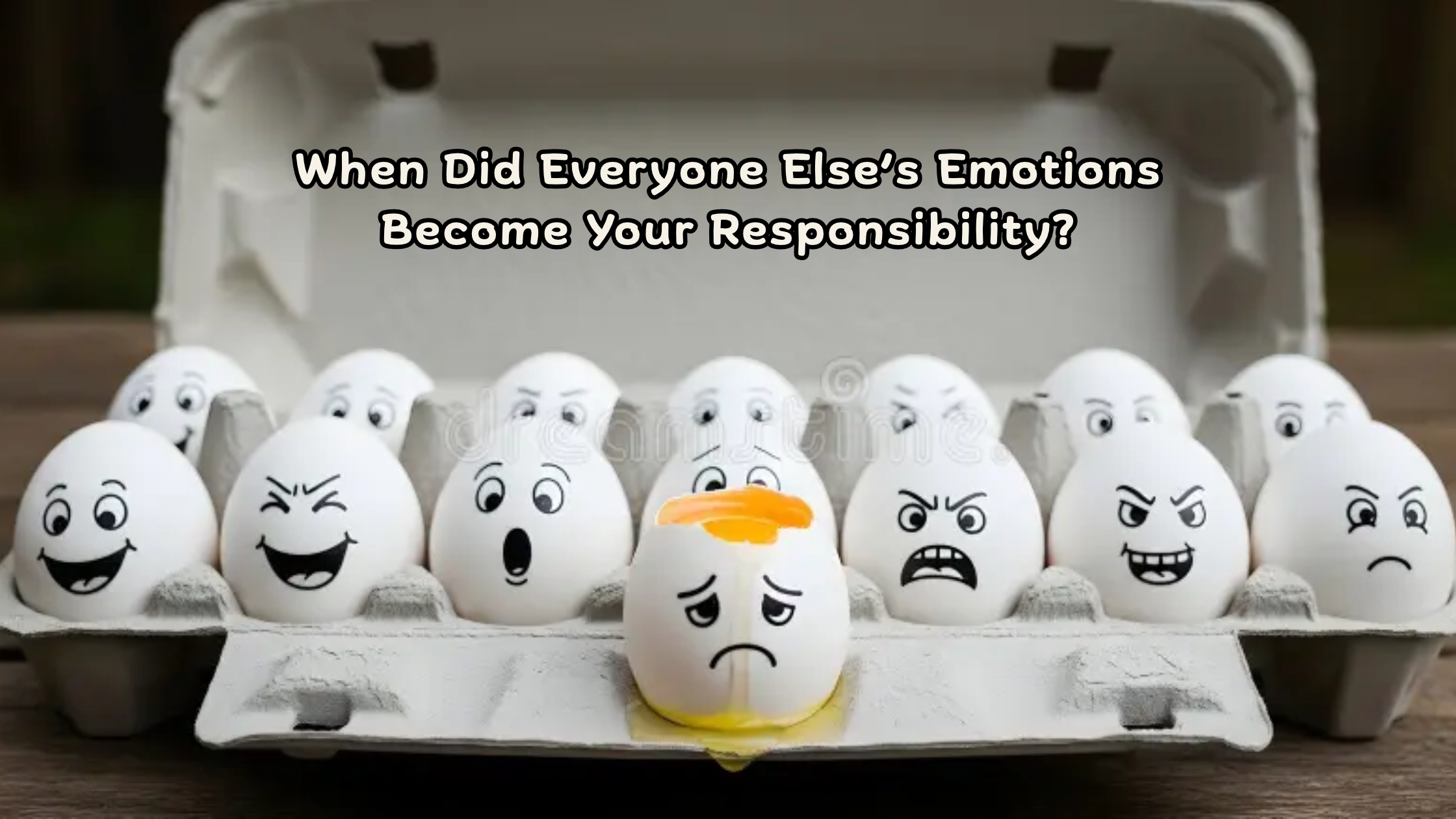
I think I’m pretty good at reading a room.
Actually, scratch that. I usually am pretty good at reading a room.
Noticing subtle changes in someone’s tone, posture, and facial expression. Sensing when tension that wasn’t there five minutes ago begins to emerge. Spotting the person who suddenly seems a little quieter. A shift in someone’s behaviour that suggests something is just… off.
For a long time, I considered that one of my strengths. I was perceptive… I was complimented on being good with people… I was able to adjust myself to whatever environment I happened to be in.
All in all, I considered myself to be pretty emotionally intelligent.
But what I’ve recently discovered is that there’s a flip-side to that skill that I wasn’t really paying attention to. And it’s an important one.
You see, the moment I noticed any of those things… I adjusted.
I began unconsciously modifying what I said. Regulated my tone. Adapted my behaviour. Started saying or doing things to try to smooth things over.
Occasionally I would even start to shrink myself, or try to become invisible enough that whatever I was sensing wouldn’t somehow end up directed toward me.
But the weird thing is that sometimes I even began adjusting myself before anything had ever happened.
Preparing myself in advance for the “what ifs”. Someone might be upset. Someone might disagree. Someone might be disappointed. So that, before the conversation even began… I’d try to re-frame what I’d been about to say to soften it… I’d edit my sentences… moderate the request… maybe even decide to just keep my mouth shut.
Apparently, I had become so proficient at walking on eggshells that I was sweeping the fucking things up before the eggs had even been laid.
But recently I’ve begun to ask myself, “Is this actually emotional intelligence?”. Or have I unconsciously appointed myself the unpaid emotional custodian of every room I walk into?
Emotional Intelligence and the Fine Art of Keeping Everybody Happy
It’s important to remember that emotional intelligence absolutely does include being able to recognize emotions. Our own, as well as other people’s. The ability to notice that someone is angry, hurt, anxious, disappointed, or uncomfortable helps provide some very useful information about what’s going on during an interaction or in the environment we’re interacting in.
However… many of us have inadvertently added something to the equation that makes a huge difference.
Responsibility.
Someone’s uncomfortable? We act to try to make them comfortable.
Someone’s angry? We try to say or do something to fix it.
Someone’s disappointed? We immediately wonder what we did wrong.
And sometimes we merely anticipate that someone might react badly… or simply detect an emotional shift… and without identifying whether it has anything to do with us at all… it’s enough for us to start behaving as though we’ve been assigned the role of emotional moderator, and try to mitigate everyone else’s reactions.
However, there is an important distinction between being emotionally intelligent and being an emotional moderator. Because constantly monitoring the emotional environment around us - and subsequently modifying ourselves in response to it - can look surprisingly similar to emotional intelligence from the outside.
From other people’s perspectives, those behaviours are often viewed as strengths. We might even be praised for it. Told we’re easy-going, thoughtful, accommodating, or good at keeping the peace.
But if we look closer at those behaviours, there can also be tendencies for people-pleasing, conflict avoidance, shitty boundaries, or too long living with a nervous system that became exceptionally good at scanning our environment for signs that something might be wrong.
And that is fucking exhausting.
It’s important to understand that other people’s emotions can be information without automatically becoming instructions.
Why We Get So Good at Listening for the Eggshells
Our brains evolved to prioritize scanning for and ascertaining safety. And for some of us, at sometime in our life – or many times - conflict became something our brain learned it needed to pay close attention to.
Maybe disagreeing had consequences. Maybe ensuring that someone else was happy made life easier. Maybe being agreeable, helpful, quiet, or accommodating helped reduce tension.
So we learned…
Read the room… adapt… appease… smooth things over… keep the peace… It became more than a habit. It became instinctual and normal for us.
When we do something often enough, eventually it is no longer something we consciously choose to do. It simply feels like part of who we are.
Until, perhaps, we reach a point where consciously or unconsciously, something says, “Enough”, and we’re suddenly wondering why our patience seems to have vanished. Why we seem to have less tolerance for certain behaviours. Why we just no longer have the energy or desire to manage everyone else’s response to everything we say and do. Why our once-abundant supply of give-a-fucks seems to have dwindled to a small emergency reserve we’re saving in case we need them to keep our jobs.
Maybe we’re becoming less patient… But I think maybe there’s something else happening too.
My theory is that we’re becoming more discerning.
Caring Isn’t the Same as Owning
And… before we swing the pendulum all the way over to, “Well, fuck everybody else’s feelings. Sounds like a them-problem.”
No. That is not emotional intelligence either. Other people’s emotional responses sometimes do contain information that we genuinely need to hear.
If I say something shitty to someone I love and they’re hurt by it, I don’t get to shrug and announce that their feelings aren’t my responsibility.
My behaviour contributed to what happened. Maybe I need to apologize. Maybe I need to repair something. Maybe what I said came out completely differently than I intended and I need to explain myself better. Or maybe I need to just shut up for five minutes and actually listen.
That matters too.
The distinction I’m working on learning to make, is between caring about someone’s emotional experience and taking ownership of it. Because those are not the same thing. And separating them requires discernment.
When someone reacts negatively to something I’ve said or done, I can ask:
Did I behave in a way I’m not proud of?
Did I say something unnecessarily hurtful?
Did I violate my own values?
Is there something here that genuinely needs repair?
Or…
Are they uncomfortable because I disagreed with them?
Because I said no?
Because I expressed a need?
Because I didn’t give them what they wanted?
Because I stopped playing a role they had become accustomed to me playing?
Someone being unhappy with my behaviour doesn’t automatically mean my behaviour was wrong. Sometimes it simply means they’re unhappy. And they’re allowed to be.
Discomfort Isn’t a Crisis
This one is taking some work for me. Because when you’re accustomed to listening for the crunch of eggshells, someone else’s discomfort can feel like evidence.
Something’s wrong… I’ve done something… Fix it.
The truth is that another adult experiencing an uncomfortable emotion is not necessarily an emergency requiring my intervention.
I can care that someone is upset. I can listen. I can be curious about their experience. I can honestly examine my contribution. And when I’ve done something that requires accountability, I can own it.
But this is the really important part… I can also allow another person to be disappointed, frustrated, irritated, or uncomfortable without automatically turning myself inside-out to make their feeling disappear.
Allowing ourselves and others space and grace to actually have our emotions - instead of immediately trying to fix, suppress, avoid, or manage them - is part of emotional intelligence too.
Maybe the Give-a-F*cks Aren’t Actually Gone
I’ve joked more than once that somewhere around midlife, along with some important hormones, most of my give-a-f*cks apparently packed up and abruptly left. (Seriously… it almost felt like it happened over night. One day I had a box full of them and was handing them out like candy… the next day I was frantically rummaging in the bottom of my desk drawer desperately hoping I could find even one to get me through until I could escape to my truck and breathe…). And the truth is that some days it definitely still feels that way.
But I’ve started wondering lately whether they’re actually gone.
Because I think emotional intelligence isn’t necessarily about becoming easier for everybody else to be around. Maybe it’s about becoming more honest to be around.
Maybe it isn’t about keeping the peace at any cost. Maybe it’s learning the difference between empathy and obligation. Between accountability and ownership. Between the emotions that belong to us… and the ones we’ve simply become accustomed to carrying.
And maybe it’s learning that someone else’s discomfort isn’t ours to manage… or evidence that we’ve done something wrong.
Maybe I haven’t stopped caring.
Maybe I’m finally learning where caring ends and responsibility begins.
And maybe some of those give-a-f*cks didn’t actually disappear after all.
Maybe I’m just no longer spending them on shit that was never mine to spend them on in the first place.