Pull Up a Chair: What Uncertainty Does to Us While We Wait
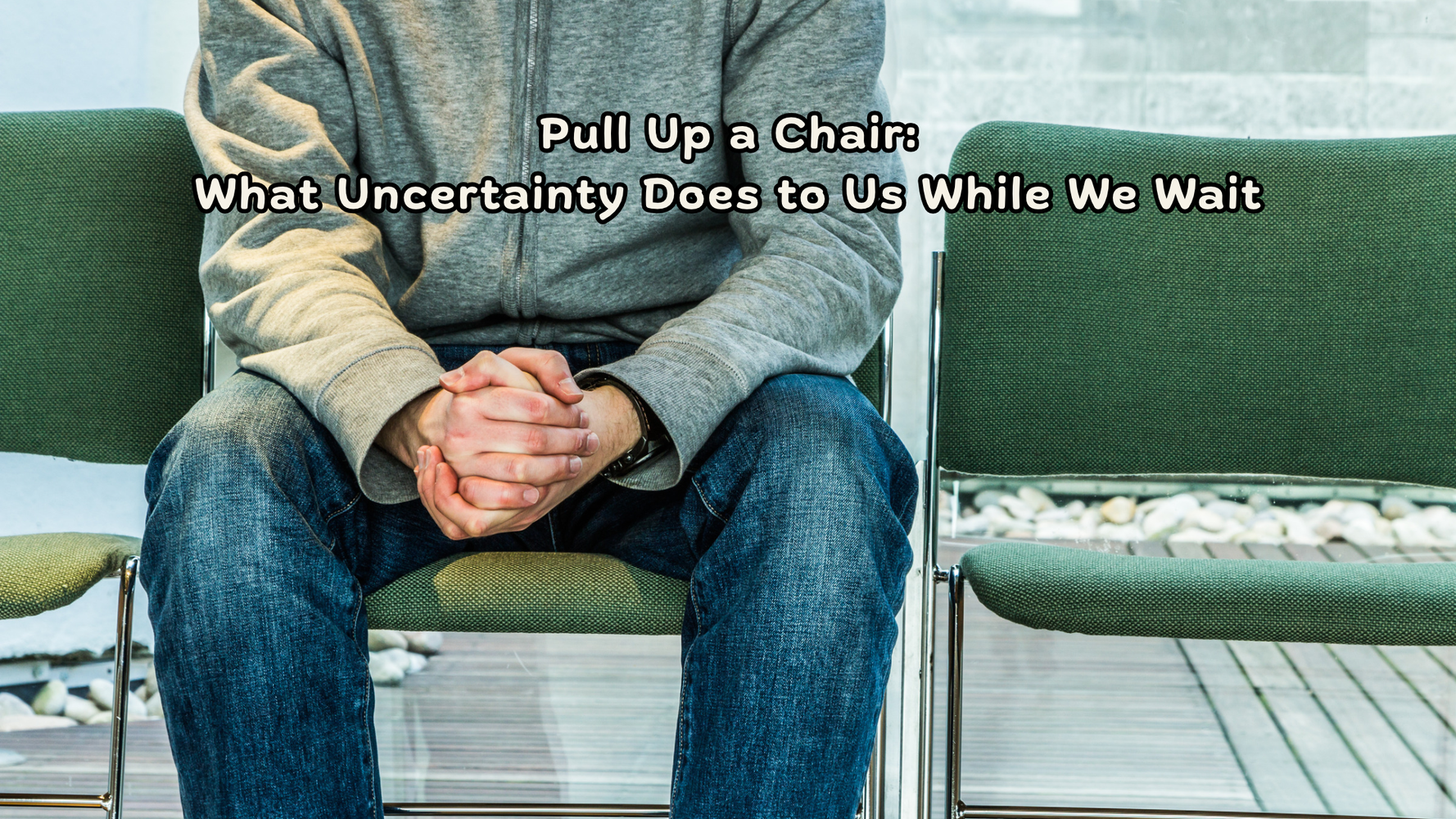
There are few things the human brain enjoys less than an unanswered question. And at one point or another, we’ve all occupied the space between when the question appears… and we finally get an answer.
Maybe you're waiting for medical results. Maybe you're waiting to hear whether you got the job. Maybe someone you love is late getting home. Maybe you're waiting for a court decision, an important phone call, or the second half of a conversation that could change a relationship.
Whatever put you there, eventually most of us spend some time in the waiting room.
That uncomfortable space between: Something might happen...
And: Now I know.
When information is incomplete, our brains don’t really sit that well with leaving that empty space empty.
I spent a few weeks in one of those waiting rooms recently after an unexpected finding on a routine medical screening required some follow-up.
Everything eventually turned out fine.
But while I was waiting for that answer, I became fascinated by what was happening inside me.
Not always fucking delighted by it. But fascinated.
Because uncertainty, it turns out, can make weird things happen to someone who is normally pretty rational.
Our brains are constantly making predictions.
We use previous experiences, information and patterns to anticipate what might happen next. And it’s pretty useful in everyday life – helping us do a lot of the things we do on a day-to-day basis without having to think a lot about them.
Then uncertainty shows up.
There's an important question.
We don't have enough information to answer it.
And somewhere inside the metaphorical boardroom of my brain, Prediction walks in.
Enter Fucking Nostradamus
He is extremely confident – but nobody has informed him that he can’t really see the future. So he's spectacularly under-qualified for anything but guess-work.
Because Prediction cannot actually see the future, but give him enough uncertainty, and he will happily rummage through what we've experienced before, what we've watched happen to other people, things we've heard or read, and whatever other scraps of information happen to be lying around, and use that to start constructing increasingly detailed versions of what might happen next.
And our internal Nostradamus appears to be highly allergic to, "I don't know".
So the longer the blank page sits there, the more tempting it becomes to start filling it.
What if this happens?
And then what?
What would I do?
What would happen after that?
Before long, our brain isn't producing a vague hypothetical screenplay anymore. It's developed a full-length feature film. With characters, dialogue, sets… and maybe a sequel waiting in the wings.
And somewhere along the way… possibility can start sounding an awful lot like probability.
Fear Doesn't Always Arrive First
One of the most interesting things I noticed during my own little waiting period was that I wasn't particularly scared at first.
I was worried. I was definitely distracted. But scared? Not really. (And I know hindsight can rewrite our emotional memories, which is one reason I decided to keep notes at the time.)
My body, however, had apparently received different information.
At first I just noticed that my heart rate was higher... My breathing was shallower... That I my ability to concentrate went to shit... And as I continued to return to the same unresolved question, I was making stupid mistakes at work.
Then my sleep went very quickly downhill... My shoulders were constantly tense and my jaw was under the impression that we were preparing for battle.
And over time, as my brain had more opportunity to build increasingly imaginative possible futures, fear finally walked through the front door too.
That's something I think we sometimes lose when we summarize difficult periods after they're over.
We say:
“I was terrified.”
“I was anxious for three weeks.”
“I was devastated.”
But our emotions can rarely be summed up that tidily.
During those weeks, I was worried. I was hopeful. I was distracted. I got angry. I was sometimes scared.
But sometimes I laughed… and sometimes I became absorbed in something and forgot about the whole thing for awhile.
And sometimes several of those things showed up pretty much simultaneously.
We can believe something will probably be okay and be afraid it won't. We can be hopeful and scared. We can be grateful for the people around us and pissed off that we’re in the situation at all. We can laugh while a baby elephant’s fat ass is sitting on our chest.
Contradictory emotions don't equal “coping badly”. Sometimes emotions just co-exist.
Knowing What's Happening Doesn't Make You Immune to It
Here's where things got even more interesting for me.
I knew what was happening. I have a pretty good understanding of how our stress response works. I'm usually able to recognize when I’m catastrophizing. I've spent years learning about emotions, mindfulness, resilience and the ways our brains respond to perceived threats. And I also spent enough quality time that first week with Dr. Google to know the available information was overwhelmingly reassuring.
My nervous system did not even remotely give a shit.
It metaphorically made a paper airplane out of all that useful information, shot it out the window and yelled, “DID YOU NOTICE THE GRIZZLY BEAR BEHIND THAT BUSH?!”
Because knowledge isn't an OFF switch.
Understanding can give us perspective and help us recognize what's happening. It can help us choose how we respond and look for something that might help. But understanding why you're struggling doesn't mean you are therefore able to stop struggling.
I think understanding that matters.
Because otherwise even self-awareness can become another stick that we use to beat ourselves up with.
I know better.
I've learned this.
I have tools.
I've been through worse.
I should be handling this better.
Understanding doesn’t make us immune to having an emotional or physical response to what’s going on.
When the Toolbox Becomes Just Another Job
I've talked many times about my metaphorical resilience toolbox. It's where I keep the strategies I've accumulated over the years that sometimes help when life gets messy.
Mindfulness… Journalling… Rhythmic breathing… Humour… Distraction… Fact-checking… Talking to people I trust… And occasionally driving around in my truck with the music loud enough that I can't hear what a terrible singer I am.
But during those weeks, my toolbox metaphor started to evolve. I realized that I couldn’t carry every single tool around all of the time.
My metaphor bloomed into a whole workshop. The workshop is where we can learn new tools, experiment with them, repair old ones, or decide something everyone else swears by is absolutely useless in our particular hands.
Because tools are personal. There is no universally perfect coping strategy.
And I noticed another problem with the toolbox metaphor. Sometimes we start believing that if we use the right tool correctly, we should feel better.
Journal → worry gone.
Deep breathing → calm.
Take a walk → serenity.
Mindful cup of tea → congratulations, you're Buddha.
Real life doesn't always work that way. Sometimes journalling didn't eliminate my worry. It stopped the worry from bleeding into the next four hours. Sometimes distraction gave my nervous system half an hour off. Sometimes breathing didn't make me calm. It just helped my shoulders drop from somewhere around my ears back toward their anatomically intended position. Sometimes talking to someone didn't solve a single fucking thing. It just meant I wasn't alone.
That's still helping.
A tool doesn't have to eliminate our distress to be useful, and still feeling like shit doesn't necessarily mean the tool failed.
But there was another lesson hiding in that workshop too.
Sometimes…
put the fucking toolbox down.
Because there were days when coping started feeling like another task.
Breathe.
Journal.
Walk.
Name the emotion.
Reframe the thought.
Regulate.
Regulate.
Regulate.
Eventually I found myself wondering, “What if I don't fix this today?”
What if I admit I'm scared… or tired… or angry…? Or simply done trying to turn today’s shitty feelings into tomorrow’s personal-growth lesson.
What if today I just sit here and be a woman having a difficult fucking day?
The House We Live In
As I spent more time thinking about the toolbox, an entire metaphorical house started constructing itself around it.
The workshop holds the tools.
There's an attic full of old beliefs, memories and several recurring podcast residents who really should start paying rent.
There's a foundation made up of things like our relationships, values and health.
There's a porch where we can step outside and check the weather. Although if we sit there constantly scanning the horizon for storms, Fucking Nostradamus will inevitably pull up a chair beside us.
And then there's the kitchen.
That's where life happens. Coffee… Dinner... Work… Conversations… Laughter… Dishes somebody should have washed yesterday… Ordinary life.
And somewhere along the way I realized... The goal isn't to become really good at finding the workshop. The goal is to spend as much time as we can back in the kitchen, living our lives.
We don't build resilience so we can spend our lives constantly regulating ourselves. We gather and nurture resources that can help us navigate the shit that happens so that we can get back to living our life as quickly as we can.
But do you know what? Sometimes we need to just give ourselves permission to sit on the porch and admit we don’t like storms.
The toolbox – and the workshop - will still be there tomorrow.
Pull Up Another Chair
Something else became increasingly clear while I waited.
Even when uncertainty technically belongs to one person, we rarely experience it entirely alone. The people around us join us in that metaphorical house too. And sometimes we support people based on what we think they're afraid of.
My husband and I discovered that we'd been doing exactly that. His biggest fear wasn't actually mine. Mine wasn't his. We were both worried about the same situation while imagining very different versions of what made it frightening.
Which eventually led me to a question I think I'll start using moving forward… “What part of this is the hardest for you right now?”
Not “Don't worry.”
Not “I'm sure it'll be fine.”
Not even “I understand.” Because maybe we don't. We're not Nostradamus either.
Sometimes the most useful thing we can do is ask. And then listen.
We can’t always remove someone else’s uncertainty. But we can try to help them feel like they’re not in the waiting room alone.
And sometimes that's enormous.
When the Answer Arrives Before Your Body Gets the Memo
Eventually, my answer came. Everything was okay. Uncertainty over.
Mentally? Immediate relief.
Physically? Well, apparently my nervous system had some administrative paperwork to complete.
My jaw remained clenched. My sleep remained disrupted. My body was still behaving like the alarm might go off again at any moment.
That actually surprised me. I think I'd unconsciously expected:
Bad news → stress.
Waiting → stress.
Good news → relief.
THE END.
Instead, I discovered that our brain receiving an answer and our nervous system standing down don't necessarily happen at the same time. Or sometimes even all that close together. When an alarm system has been repeatedly activated - through unanswered questions, disrupted sleep, recurring thoughts and repeated moments of perceived threat - it may take some time before our body returns to baseline and the house becomes quiet again.
My body eventually did settle. Gradually.
Not dramatically. Just… gradually.
When My House Got Quiet
Once the storm has passed, hopefully we have some time to breathe. Assess the damage – if there is any. Because sometimes the storm leaves enormous damage… but sometimes it doesn’t. Even experiences that aren’t catastrophic can change our perspective.
Maybe it’s just noticing the foundation differently. Maybe it’s seeing the people sitting beside us in a different way. It might be looking more closely at our health, or our priorities, or the contents of our toolbox.
It doesn’t mean we have to believe that “difficult things happen for a reason”. Hard things don’t have to have a silver lining or be some kind of Kinder Egg with a surprise gift inside for us to notice some small thing that matters to us, or even sometimes, something to appreciate.
Maybe We Need to Rethink “Bouncing Back”
That experience also left me thinking differently about a word I've used for years. Resilience.
I've ended every episode of Transformative Journeys with: "It doesn't matter if you fall. What matters is how well you bounce."
I still believe deeply in our capacity to adapt, rebuild and keep moving. But I'm becoming increasingly uncomfortable with turning resilience into another fucking performance review.
Used your coping tools? Medal.
Bounced back? Medal.
Bounced back quickly? Congratulations! You get a trophy!
What happens when someone simply doesn't have much bounce available?
Maybe you’re exhausted. Maybe you don't have the support someone else has. Maybe you’re carrying financial stress, caregiving, grief, health problems or seventeen other things nobody else sees. Maybe you’ve spent most of your capacity surviving what happened yesterday. Maybe the next storm arrived before the house was completely repaired from the last one.
Sometimes resilience might look like getting back up.
Sometimes it might be deciding what you can’t do today, or accepting help. Or asking for it.
Sometimes it’s crying… or resting… or letting someone else carry part of the load.
Sometimes it might mean lying on the metaphorical workshop floor and deciding you have absolutely no interest in picking up another fucking tool today.
And sometimes?
Maybe there's just no bounce available.
Maybe you figure out how to roll.
We'll work on standing later.
If You're Sitting in the Waiting Room
I wish I could end this by telling you how to make uncertainty comfortable.
I can't.
And I'm certainly not going to sprinkle optimism fairy dust over the situation and promise everything will turn out exactly as you hope.
Sometimes we simply don't know. That's the fucking problem.
But if you're sitting in your own waiting room right now, maybe you don't need another person telling you to stop worrying. Maybe you need someone to pull up a chair. Maybe you use whatever tools help. Maybe you let someone sit beside you. Maybe you remind yourself that possibility isn't probability. Maybe you recognize that understanding your response doesn't obligate you to switch it off.
And maybe, for today, you put the toolbox down.
Because sometimes there isn't anything to fix. Sometimes we're simply people sitting in an uncomfortable chair… waiting for an answer we don't have yet.
And perhaps we can give ourselves - and each other - a little more grace while we wait.